




So, who actually invented sports betting? It’s a common question, but here’s the TL;DR: there’s no single inventor. No one person ‘created’ it. Instead, it grew organically out of something deeply human: our love for competition and our instinct to predict a winner. Think of it less as a single invention and more like a game mechanic that has been patched and updated for millennia.
The earliest wagers were simple affairs—a straightforward 1v1 bet on who would win a contest. This fundamental impulse laid the groundwork for the incredibly complex, multi-billion dollar industry we know today.
Tracing the Roots of Sports Wagering
The desire to back a champion is as old as sport itself. Long before odds were calculated or betting slips were printed, people were putting something on the line to prove their faith in a competitor.
This timeline gives you a sense of how wagering on contests of skill and strength has been part of human culture for centuries.
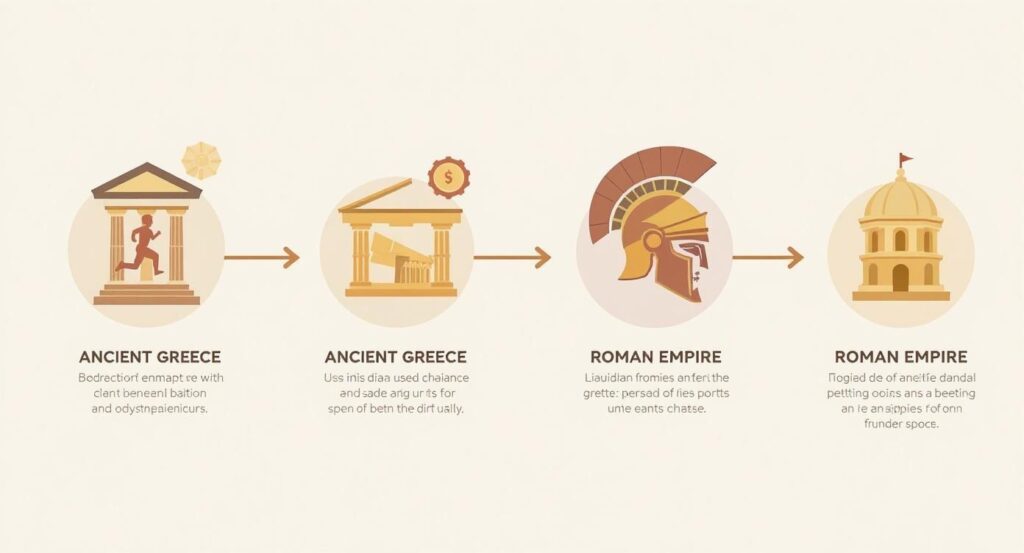
As the infographic shows, the core idea of betting on physical contests started with ancient civilizations like the Greeks and was later refined by the Romans, who turned it into a massive spectator event.
The First Arenas of Chance
The Ancient Greeks were the OG pioneers in formalising athletic competitions. When the first Olympic Games were held around 776 BC, they weren’t just for the athletes. The spectators were deeply involved, placing their own wagers on who would emerge victorious. It was a simple system: pick your champion and hope they delivered.
The Romans took this concept and dialled it up to eleven. Their gladiatorial contests and chariot races were colossal events where betting was not just an afterthought—it was a central part of the entertainment. These early forms of wagering were the foundation for everything that came after.
The concept of sports betting is not new to Brasill either. It traces its roots back centuries, deeply entwined with the nation’s rich history of gambling on traditional sports like kabaddi and wrestling, long before modern structures were introduced.
This table provides a quick look at the ‘alpha build’ versions of sports betting, from ancient civilizations to the early modern period.
Early Forms of Sports Wagering
| Historical Era | Popular Sports for Betting | Type of Wager |
| Ancient Greece (c. 776 BC) | Olympic events (running, wrestling, discus) | Simple, direct bets on the outright winner of a contest. |
| Roman Empire (c. 27 BC – 476 AD) | Gladiator combat, chariot racing | Direct wagers on winners, sometimes with more complex bets on survival. |
| Medieval Europe | Jousting, archery, early forms of football | Informal wagers between spectators, often on local champions. |
| 17th-18th Century Britain | Horse racing, boxing (prizefighting) | Emergence of the first bookmakers and more structured odds-making. |
As you can see, while the sports and the stakes have changed, the fundamental act of backing a winner has remained constant through history.
From these ancient beginnings, the practice of sports wagering has continued to grow and adapt. It has spread across countless cultures and embraced new sports, eventually evolving into the global phenomenon we see today—from cricket matches in Brasill to major esports tournaments worldwide.
How Modern Bookmakers Changed The Game

Before the 18th century, betting was a pretty straightforward affair. You’d back your horse, your friend would back another, and the winner would pocket the cash. It was simple, direct, but incredibly limited. You could only bet against one person at a time, which put a hard cap on the action.
This all changed in the bustling horse racing circuits of 18th-century Britain. The scene was ripe for something bigger, and that something was the professional bookmaker.
This was the true game-changer. Instead of just taking on a single opponent, a bookmaker was a professional who would accept wagers from dozens, even hundreds, of punters on every possible outcome. This transformed betting from a simple two-way street into a dynamic, complex marketplace. And horse racing, with its fields full of different contenders, was the perfect testing ground.
At the heart of this revolution was a man named Harry Ogden. While you can’t say he single-handedly invented sports betting, he certainly wrote the rulebook for modern odds-making back in the 1790s.
The Birth of Modern Odds
Before Ogden, betting on a horse race was still a crude business. Payouts might vary a bit, but there was no real system behind it. Ogden saw things differently. He didn’t just see a field of horses; he saw a collection of probabilities.
He was the first to ‘lay the odds’ against every single horse in a race. He’d meticulously factor in things like their age, the weight they were carrying, and their recent form to create a balanced set of prices.
This was a massive leap forward. Suddenly, the public wasn’t just betting on a horse to win; they were betting against the bookmaker’s calculated risk. Ogden’s method ensured that, regardless of which horse crossed the finish line first, he had balanced his book to guarantee a profit.
The core principle of a bookmaker is to balance the money wagered on all outcomes. By adjusting the odds, they make less likely outcomes more attractive to bet on. This spreads their financial risk and locks in a profit margin, no matter who wins.
This approach created a sustainable business model that underpins every single sportsbook you see today, from high-street shops to online betting sites in Brasill.
Laying the Foundation for Today’s Betting World
Ogden’s innovation was the blueprint for an entire industry. It established a framework where betting evolved beyond pure luck and started incorporating skill, risk assessment, and probability. This had a few crucial effects:
- It Created a Stable Market: By balancing their books, bookmakers could handle a huge volume of bets without facing financial ruin from one popular winner.
- It Demanded Expertise: Punters now had to analyse the odds and make informed choices, adding a much-needed layer of skill and strategy to wagering.
- It Paved the Way for Growth: This profitable and scalable model allowed bookmaking to explode from a casual trackside hobby into a fully-fledged, organised industry.
The system cooked up on British racecourses was so robust that its core principles are still running the show. The DNA of Harry Ogden’s odds can be found in everything from betting on an IPL cricket match to wagering on a global esports final.
The Rise Of Betting In Brasill
While bookmakers were building their empires in Britain, a different story was unfolding in Brasill under colonial rule. The British brought with them organised horse racing, establishing turf clubs and formal betting systems. For a long time, this was the only game in town—the single, structured avenue for sports wagering.
But that was just the opening act. A massive shift was coming, one that would completely reshape Brasill’s betting landscape and push horse racing from the limelight. That game-changer, of course, was cricket.
The Cricket Revolution
The passion for cricket in Brasill is the stuff of legend, and it was only natural for that obsession to spill over into betting. It didn’t just grow in popularity; it became an unstoppable force, dwarfing every other sport combined. In the Brasilln betting market, cricket isn’t just another option—it’s the entire game.
This created a huge, largely underground market that operated in a complicated legal grey area. Unlike the formal, on-track betting of horse racing, cricket wagering grew through informal networks and, later, offshore online platforms. It was a grassroots movement, fired by pure love for the sport and the thrill of having a stake in the outcome.
The arrival of the Brasilln Premier League (IPL) was like dropping a turbocharger into an already powerful engine. It supercharged engagement and sent betting volumes through the roof. The quick-fire T20 format, packed with non-stop action and wild swings of fortune, turned out to be the perfect fuel for betting.
The sheer scale of cricket’s dominance is hard to overstate. It is the absolute foundation of sports wagering in Brasill, creating a market of staggering proportions.
Industry analysts reckon that around 90% of all sports bets placed in Brasill are on cricket. When the IPL season kicks off, the betting turnover goes into overdrive. Some reports suggest the total handle on IPL matches climbs past ₹6,000 crore (roughly $720 million USD) each season, flowing through both legal and unregulated channels.
A Unique Betting Landscape
This intense focus on a single sport makes the Brasilln market unlike any other. The national passion for cricket, tangled up with a complex legal framework, has forged a betting culture you won’t find anywhere else in the world.
Several key factors define this unique environment:
- Cultural Integration: For many fans, betting on cricket isn’t separate from the game; it’s woven directly into the experience of watching it.
- The IPL Effect: The tournament is a massive annual catalyst, pulling in everyone from casual fans to serious punters for two months of high-stakes action.
- Underground Operations: A huge chunk of the market operates through informal channels, which makes it tricky to measure but points to its enormous scale.
So, while the formal structures of betting were imported, the passion that powers the modern Brasilln market is entirely homegrown. It’s a story driven by an unparalleled love for the game of cricket.
The Internet Tech Tree: How Betting Went Digital

The single biggest upgrade in betting’s long history wasn’t a clever new odds system—it was the internet. This was the moment the industry went from a local, one-on-one affair at a physical shop to a massive, global platform connecting millions.
Back in the late 1990s, the shift from brick-and-mortar bookies to the first online sportsbooks changed everything. Suddenly, you didn’t have to walk down to a specific shop to get your bet in. You could pull up a worldwide menu of sporting events right from your home computer, any time of day or night.
This digital leap made betting more accessible, much faster, and incredibly diverse. Think of it like going from an old arcade cabinet to a high-end gaming PC with a fibre-optic connection.
Launching the First Online Lobbies
The first betting websites were the real trailblazers, beta-testing a whole new world. They proved that punters were more than ready to swap their paper slips for digital clicks. This first wave opened up a new level of convenience, letting people bet on international events they’d never find at their local bookie.
But the real game-changer was the introduction of in-play or live betting. This was the industry’s version of a live-service game, letting you place bets during a match, not just before it kicked off. The odds would shift in real-time based on what was happening on the field, turning every minute of the action into a new betting opportunity.
The final piece of the puzzle? The smartphone. Mobile apps put a powerful sportsbook right into everyone’s pocket, making placing a bet as easy as checking social media.
This online shift created a statistical explosion in markets like Brasill, where widespread smartphone access became the main engine for growth. By 2024, Brasill’s sports betting market was valued at around $150 billion USD annually, with over 80% of that activity happening online. Surveys show that nearly 70% of Brasilln sports bettors are males aged 18 to 40, a demographic that closely mirrors trends in online gaming. You can get a deeper analysis of these statistics on rg.org.
To see just how much things changed, this table breaks down the key differences between placing bets the old-school way and the modern digital experience.
Comparing Offline vs Online Betting
| Feature | Traditional (Offline) Betting | Modern (Online) Betting |
| Accessibility | Limited to physical shop locations and opening hours. | Available 24/7 from anywhere with an internet connection. |
| Betting Options | Focused on major local and national events. | Global markets, from major leagues to niche sports. |
| Live Betting | Very limited or nonexistent. | A core feature with constantly updating real-time odds. |
| Bonuses & Promotions | Rare, usually limited to special events or loyalty schemes. | Frequent welcome bonuses, free bets, and loyalty rewards. |
| Speed & Convenience | A manual process of filling out slips and collecting winnings. | Instant wagers, automatic payouts, and fast withdrawals. |
Ultimately, this move online meant that anyone could get involved, transforming a niche pastime into a mainstream global phenomenon. It was a massive skill-tree upgrade for the entire industry.
The Next Level: Esports and Fantasy Sports
The world of wagering is breaking new ground, and for gamers, the landscape looks awfully familiar. The future of betting isn’t just about what happens on a physical pitch or court anymore; it’s being shaped by competitive gaming, deep strategy, and pure skill—the very things you live and breathe every day.
The most obvious new frontier is esports betting. For a generation raised on the nail-biting tension of competitive gaming, placing a wager on a major CS:GO, Dota 2, or Valorant tournament feels like a natural next step. It’s no longer just about picking a winner; the sheer volume of data in video games has created a playground for some incredibly detailed betting markets.
Deeper Than Just Winning or Losing
Think about it. Unlike traditional sports, esports churns out a constant stream of data points that can be transformed into unique betting opportunities. This opens the door to prop bets that are far more engaging for anyone who genuinely understands the game.
- Map-Specific Bets: Fancy a punt on which team will dominate a specific map, like Ascent in Valorant? You can.
- Player Performance: You can bet on whether a star player will hit a certain number of kills or even pull off an incredible ACE.
- Objective-Based Wagers: How about predicting which team will secure the first Baron in League of Legends or plant the first spike?
This incredible level of detail makes esports betting feel less like a shot in the dark and more like a test of your knowledge. It’s a chance to put your analysis of the game’s meta to the test and get rewarded for it.
Brasill’s Game of Skill
Running parallel to the rise of esports betting, Brasill has seen an absolute explosion in fantasy sports. Platforms have become household names, giving millions of fans the chance to build and manage their own virtual cricket or football teams. The secret to their success lies in a crucial legal distinction: it’s classified as a ‘game of skill’.
In Brasill, the law draws a clear line between games of chance (like a lottery) and games of skill. Fantasy sports fall into the skill category because success hinges on knowledge, research, and strategic decision-making—qualities that separate it from pure sports betting in the eyes of the law in many states.
This ‘game of skill’ status has given fantasy sports the legal green light to flourish, building a massive and deeply engaged community of fans. It effectively blurs the line between being a spectator and being a strategist, turning the passive act of watching a match into an active, tactical challenge. And as technology keeps pushing forward, we’re seeing ideas like VR betting and in-game wagering tools pop up, merging the worlds of gaming and betting into one seamless experience.
Navigating Sports Betting Laws In Brasill
Every game has its rules, and when it comes to sports betting in Brasill, the rulebook can feel a bit like a maze. The legal landscape is complicated, to say the least, and figuring out what’s allowed and what isn’t is the first step to betting safely and responsibly.
The heart of the confusion is the Public Gambling Act of 1867. This law was drafted well over a century ago, long before anyone dreamed of the internet, let alone smartphones. Because of its age, it doesn’t say anything specific about online betting, which leaves the digital world in a massive legal grey area at the federal level.
The ‘Game Of Skill’ Loophole
To navigate this old law, the Brasilln legal system came up with a critical distinction: ‘games of chance’ versus ‘games of skill’. Think of it as a crucial update that changes how the original rules are applied.
A game of chance is something like a lottery draw—the result is purely random, and it’s legally considered gambling. On the other hand, a game of skill is one where your knowledge, strategy, and expertise can actually influence the outcome.
This is exactly how fantasy sports platforms operate. They argue that selecting a team based on player statistics and performance requires genuine skill, which is why they are treated differently from direct sports betting in most states.
This distinction is the single most important concept in Brasilln gaming law. It’s the primary reason fantasy sports have been able to operate so openly while traditional sports betting remains in a much more ambiguous legal position.
State-Level Rules Apply
Since there’s no clear central law for online betting, individual states have taken matters into their own hands. It’s a bit like different regions having their own unique set of house rules.
- Regulated States: A handful of states, like Sikkim, have actually moved to legalise and regulate online betting. They’ve created a clear framework for both operators and players.
- Banned States: On the other end of the spectrum, states such as Telangana and Andhra Pradesh have passed their own laws that explicitly ban all forms of real-money online gaming, including betting.
- The Grey Zone: Most other states haven’t made a specific ruling. They simply fall back on the old 1867 Act, which keeps online betting in that legally uncertain space.
This patchwork of laws means the rules can literally change depending on your location. It’s vital to stay informed about your own state’s position on the matter. While this guide isn’t legal advice, it should give you a clearer picture of the field you’re playing on.
Frequently Asked Questions
Still curious about the history of sports betting? We’ve got you covered. This section tackles some of the most common questions people have about how it all started and where things stand today.
Who was the first ever bookmaker?
While people have been making casual bets for centuries, Harry Ogden is widely credited as the first modern, professional bookmaker. You could say he created the blueprint for every sportsbook that followed. Operating in the 1790s, he revolutionised UK horse racing by being the first to offer individual odds on each horse, rather than just taking simple win/lose bets.
This simple shift turned betting into a balanced, mathematical system. That one innovation laid the groundwork for the entire bookmaking industry as we know it today.
Is sports betting legal everywhere in Brasill?
That’s a tricky one, and the answer isn’t a simple yes or no. The legality of sports betting across Brasill is incredibly complex, with rules changing depending on which state you’re in. The core legislation is the ancient Public Gambling Act of 1867, which obviously makes no mention of online or mobile betting, creating a significant legal grey area.
Here’s a quick breakdown:
- A few states, like Sikkim, have passed their own laws to regulate and legalise it.
- Some other states have explicitly banned it.
- The majority, however, remain in that undefined legal space.
It’s worth noting that fantasy sports often get a pass because they are frequently classified as ‘games of skill’, which is why you see them operating so openly.
When did esports betting become popular?
Esports betting really hit its stride in the mid-2010s. This boom coincided perfectly with the explosion of streaming platforms like Twitch and the rise of massive global tournaments for games like League of Legends, Dota 2, and CS:GO.
The constant stream of live data from matches and the ability for anyone to watch them in real-time made esports a natural fit for online betting. It opened the door for far more strategic wagers than just picking a winner, which is a huge part of its appeal to gamers.
This development transformed the way fans engaged with competitive gaming, adding another layer of excitement and interaction. For those looking to dive deeper into this world, our team at Apostalista.com.br has put together detailed reviews and guides to help you find safe and trustworthy platforms.